
Agency content repurposing work has a margin problem. The pitch is straightforward — client sends recordings, you send back content — but the delivery is bespoke every time. A writer watches the video, decides what it should become, drafts in whatever tone they remember the client liking, and hands it over. It’s profitable at one client and painful at six.
The fix isn’t hiring faster writers. It’s making the deliverable a product instead of a performance.
One recipe per client
Every client already has an implicit spec. Tone, article length, whether they say “we” or “the company,” the topics that are off-limits, the CTA at the end. Right now that spec lives in a brief nobody rereads and in the head of whoever usually does that account.
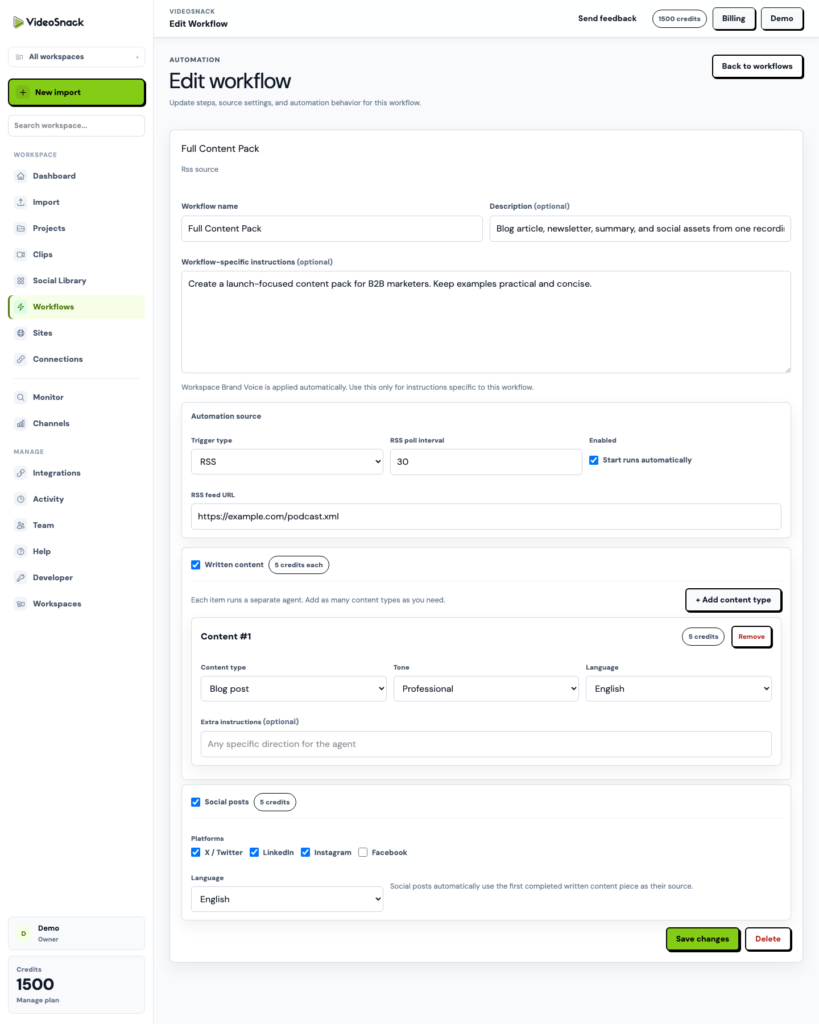
A workflow makes it explicit. Build one per client: the content steps they buy, each with tone, length, point of view, language, and the extra instructions that encode their preferences. “No first-person plural.” “Never mention pricing.” “Always close with a demo link.”
Now the deliverable is defined in the tool rather than in someone’s memory. When the account changes hands — and it will — the new person inherits a recipe, not a folder of old posts to reverse-engineer.
Intake stops being a conversation
Clients don’t send you sources in one format. Some paste a YouTube link. Some drop a Zoom export in a shared folder. One sends a transcript their VA already cleaned up, and one sends an MP3 because that’s what their recorder makes.
All of it imports: URLs, MP4 and MOV, MP3, WAV, M4A, or pasted transcripts. The transcript path is quietly the best one — if a client sends clean text, you skip transcription and go straight to generation.
Attach the client’s workflow at import and the run starts itself. Intake becomes a two-minute mechanical act rather than a decision about what this particular video should become.
Delivery, per client
Where the assets land is usually the client’s choice, not yours, so it varies:
- Their WordPress. Connect each client site with an Application Password and publish straight from the editor. Multiple sites are supported, which is the whole point — you’re routing each finished draft to a different destination and you don’t want to think hard about which.
- A Hosted Site. For campaign hubs, or clients without a CMS worth publishing into. Custom domain, branded, sitemap included.
- Files. Google Docs for clients who review in Docs. PDF for the ones who want something to approve. Social packs download as a ZIP with rendered carousel images, which is what most social deliverables actually are.
Runs are the receipts
Workflow runs track per-step status. That’s operationally useful — you can see the article is done and the social step is still going — but it’s also a record of what was produced for whom and when.
Anyone who has tried to answer “did we ever send them the newsletter for the March interview?” from a Slack search knows why that matters.
What this doesn’t do
It doesn’t remove the editor, and you shouldn’t sell it as if it did. Drafts still need someone with judgment to fix the intro, catch the claim the client can’t legally make, and add the links. The work that survives is the work clients are actually paying for.
What goes away is the setup, the format decisions, and the drift between accounts. Your writers stop doing intake and start doing editorial, which is both cheaper for you and a better job for them.
Productize one account first
Take your most repetitive client — the one who sends the same kind of recording on the same rhythm — and build their recipe. Run the next three sources through it.
If the drafts land close enough that editing beats writing, you have a service line. If they don’t, you’ve spent an afternoon.
The free trial includes 100 credits, enough to test a real client source. Start here.